Features

·

February 2, 2026

How Meteroid Helps You Implement the Pricing Strategy You Want

Is your billing system limiting your revenue potential? As SaaS moves toward consumption-based models, the ability to support complex usage logic—such as capacity commitments and tiered brackets—is becoming a competitive necessity. This article breaks down the core pricing architectures available in Meteroid, including linear per-unit billing, volume-based discounts, and slot-based seat pricing. Learn how to automate high-volume metering and eliminate manual billing errors, ensuring your RevOps team can iterate on pricing strategies in minutes rather than engineering sprints.

Designing your pricing is one thing—implementing it at scale is another. Whether you're selling simple subscriptions or complex usage-based models, Meteroid gives you the flexibility to configure and evolve your pricing—without engineering dependencies or billing headaches.

From flat fees to tiered usage rates, Meteroid supports a wide range of pricing models so you can match your monetization to how customers actually use your product.


Pricing Models You Can Build with Meteroid

Here’s how Meteroid supports major SaaS pricing model out of the box:


Flat Rate

Charge a fixed fee at regular intervals (monthly, annually, etc.).

Example: $99/month for access to the Pro plan.

Example of how flat rates are working in Meteroid

Slot-Based Pricing

Sell a fixed number of licenses, seats, or capacity units billed on a recurring basis.

Example: $200/month for 10 user seats.
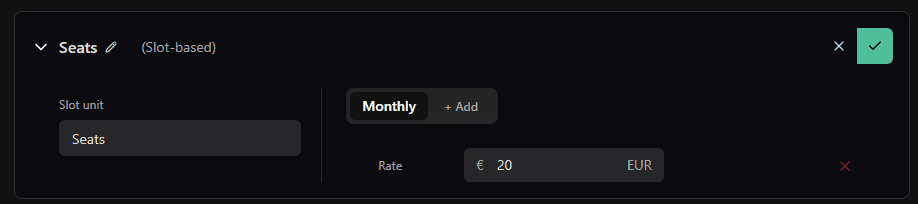
Example of how slot-based pricing is working in Meteroid

Capacity Commitments

Charge customers for a minimum committed usage or spend, while providing flexibility for additional usage.

Example: Commit to $500/month for 10k API calls and $0.01 per API call overage.
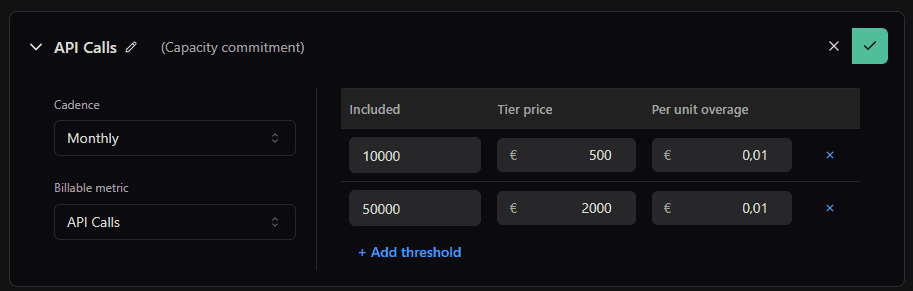
Example of how capacity commitment pricing is working in Meteroid

Usage-Based Pricing Models

All of the below models are usage-based. Charges are calculated based on how much of a specific metric (e.g. GB stored, API calls) a customer consumes.

Per Unit (Linear)

Charge a fixed rate per unit consumed.

Example: $0.05 per GB stored.
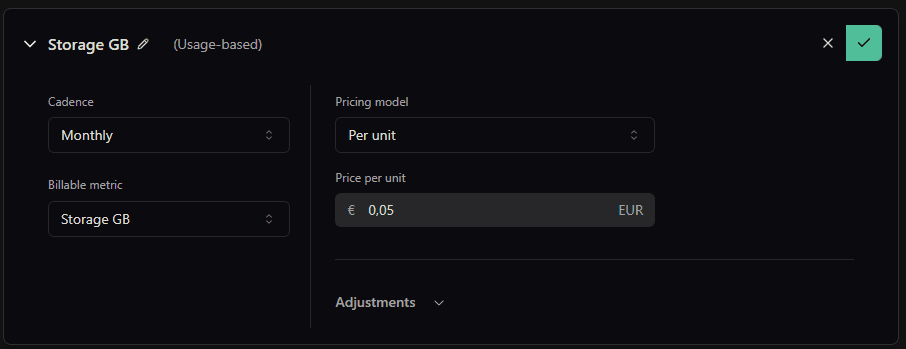
Example of how capacity commitment pricing is working in Meteroid

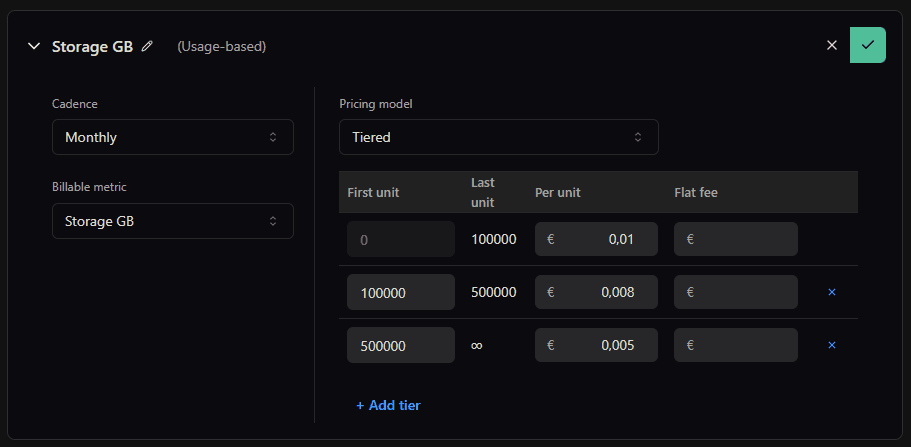
Tiered Pricing

Units are billed at different rates based on volume brackets.

Example:

  • First 100,000 API calls @ $0.01

  • Next 400,000 @ $0.008

  • Above 500,000 @ $0.005

Example of how tiered pricing is working in Meteroid

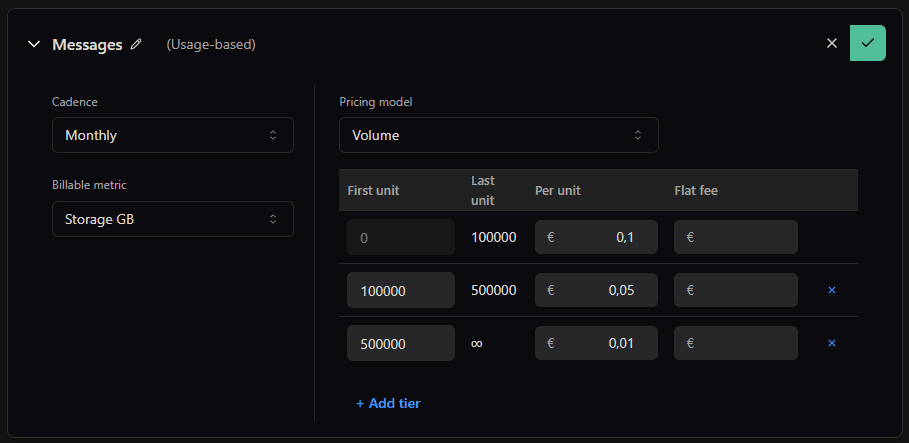
Volume-Based Pricing

Apply a single rate to all units based on total usage volume.

Example:

  • If less than 100,000 messages @ $0.1/message

  • if between 100,000 and 500,000 messages @ $0.05/message

  • If above 500,000 @ $0.01/message

Use 300,000 messages → charged at $0.05 per message for all 300,000

Example of how volume pricing is working in Meteroid

Package Pricing

Sell usage in predefined bundles or blocks.

Example: $50 per block of 100 GB stored.
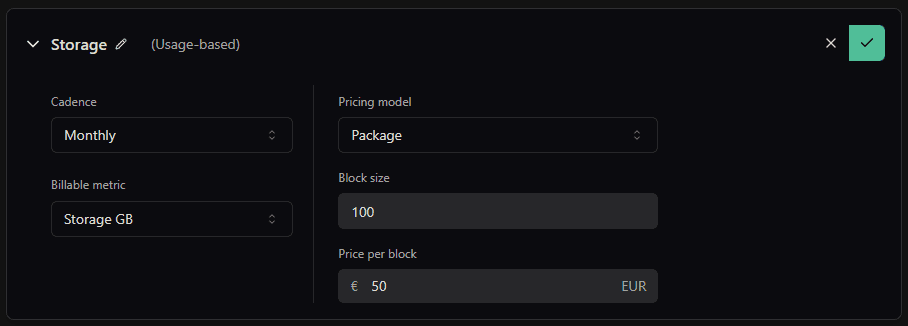
Example of how package pricing is working in Meteroid

One-Time & Recurring Charges

Meteroid supports as well both:

  • One-time charges: great for setup fees, onboarding, etc.

  • Recurring charges: for subscriptions, add-ons, support plans, and more.

All pricing components can be mixed in a single Plan—giving you complete flexibility over your monetization strategy.


Designed to iterate and scale

Your Challenge

How Meteroid Solves It

Too hard to support hybrid pricing

Combine any model: recurring + usage + one-time

Usage-based billing is error-prone

Meteroid meters, aggregates, and bills usage automatically

Need to offer pricing by customer segment

Create free, standard or custom Plans with different rules

Engineers stuck maintaining billing logic

No-code Plan editor lets Ops own pricing logic


Try It Yourself

Meteroid makes it easy to implement the pricing strategy you need—no complex config, no custom code.

👉 Create a free Meteroid account and explore all pricing options directly in your dashboard.


Designing your pricing is one thing—implementing it at scale is another. Whether you're selling simple subscriptions or complex usage-based models, Meteroid gives you the flexibility to configure and evolve your pricing—without engineering dependencies or billing headaches.

From flat fees to tiered usage rates, Meteroid supports a wide range of pricing models so you can match your monetization to how customers actually use your product.


Pricing Models You Can Build with Meteroid

Here’s how Meteroid supports major SaaS pricing model out of the box:


Flat Rate

Charge a fixed fee at regular intervals (monthly, annually, etc.).

Example: $99/month for access to the Pro plan.

Example of how flat rates are working in Meteroid

Slot-Based Pricing

Sell a fixed number of licenses, seats, or capacity units billed on a recurring basis.

Example: $200/month for 10 user seats.

Example of how slot-based pricing is working in Meteroid

Capacity Commitments

Charge customers for a minimum committed usage or spend, while providing flexibility for additional usage.

Example: Commit to $500/month for 10k API calls and $0.01 per API call overage.

Example of how capacity commitment pricing is working in Meteroid

Usage-Based Pricing Models

All of the below models are usage-based. Charges are calculated based on how much of a specific metric (e.g. GB stored, API calls) a customer consumes.

Per Unit (Linear)

Charge a fixed rate per unit consumed.

Example: $0.05 per GB stored.

Example of how capacity commitment pricing is working in Meteroid

Tiered Pricing

Units are billed at different rates based on volume brackets.

Example:

  • First 100,000 API calls @ $0.01

  • Next 400,000 @ $0.008

  • Above 500,000 @ $0.005

Example of how tiered pricing is working in Meteroid

Volume-Based Pricing

Apply a single rate to all units based on total usage volume.

Example:

  • If less than 100,000 messages @ $0.1/message

  • if between 100,000 and 500,000 messages @ $0.05/message

  • If above 500,000 @ $0.01/message

Use 300,000 messages → charged at $0.05 per message for all 300,000

Example of how volume pricing is working in Meteroid

Package Pricing

Sell usage in predefined bundles or blocks.

Example: $50 per block of 100 GB stored.

Example of how package pricing is working in Meteroid

One-Time & Recurring Charges

Meteroid supports as well both:

  • One-time charges: great for setup fees, onboarding, etc.

  • Recurring charges: for subscriptions, add-ons, support plans, and more.

All pricing components can be mixed in a single Plan—giving you complete flexibility over your monetization strategy.


Designed to iterate and scale

Your Challenge

How Meteroid Solves It

Too hard to support hybrid pricing

Combine any model: recurring + usage + one-time

Usage-based billing is error-prone

Meteroid meters, aggregates, and bills usage automatically

Need to offer pricing by customer segment

Create free, standard or custom Plans with different rules

Engineers stuck maintaining billing logic

No-code Plan editor lets Ops own pricing logic


Try It Yourself

Meteroid makes it easy to implement the pricing strategy you need—no complex config, no custom code.

👉 Create a free Meteroid account and explore all pricing options directly in your dashboard.


Designing your pricing is one thing—implementing it at scale is another. Whether you're selling simple subscriptions or complex usage-based models, Meteroid gives you the flexibility to configure and evolve your pricing—without engineering dependencies or billing headaches.

From flat fees to tiered usage rates, Meteroid supports a wide range of pricing models so you can match your monetization to how customers actually use your product.


Pricing Models You Can Build with Meteroid

Here’s how Meteroid supports major SaaS pricing model out of the box:


Flat Rate

Charge a fixed fee at regular intervals (monthly, annually, etc.).

Example: $99/month for access to the Pro plan.

Example of how flat rates are working in Meteroid

Slot-Based Pricing

Sell a fixed number of licenses, seats, or capacity units billed on a recurring basis.

Example: $200/month for 10 user seats.

Example of how slot-based pricing is working in Meteroid

Capacity Commitments

Charge customers for a minimum committed usage or spend, while providing flexibility for additional usage.

Example: Commit to $500/month for 10k API calls and $0.01 per API call overage.

Example of how capacity commitment pricing is working in Meteroid

Usage-Based Pricing Models

All of the below models are usage-based. Charges are calculated based on how much of a specific metric (e.g. GB stored, API calls) a customer consumes.

Per Unit (Linear)

Charge a fixed rate per unit consumed.

Example: $0.05 per GB stored.

Example of how capacity commitment pricing is working in Meteroid

Tiered Pricing

Units are billed at different rates based on volume brackets.

Example:

  • First 100,000 API calls @ $0.01

  • Next 400,000 @ $0.008

  • Above 500,000 @ $0.005

Example of how tiered pricing is working in Meteroid

Volume-Based Pricing

Apply a single rate to all units based on total usage volume.

Example:

  • If less than 100,000 messages @ $0.1/message

  • if between 100,000 and 500,000 messages @ $0.05/message

  • If above 500,000 @ $0.01/message

Use 300,000 messages → charged at $0.05 per message for all 300,000

Example of how volume pricing is working in Meteroid

Package Pricing

Sell usage in predefined bundles or blocks.

Example: $50 per block of 100 GB stored.

Example of how package pricing is working in Meteroid

One-Time & Recurring Charges

Meteroid supports as well both:

  • One-time charges: great for setup fees, onboarding, etc.

  • Recurring charges: for subscriptions, add-ons, support plans, and more.

All pricing components can be mixed in a single Plan—giving you complete flexibility over your monetization strategy.


Designed to iterate and scale

Your Challenge

How Meteroid Solves It

Too hard to support hybrid pricing

Combine any model: recurring + usage + one-time

Usage-based billing is error-prone

Meteroid meters, aggregates, and bills usage automatically

Need to offer pricing by customer segment

Create free, standard or custom Plans with different rules

Engineers stuck maintaining billing logic

No-code Plan editor lets Ops own pricing logic


Try It Yourself

Meteroid makes it easy to implement the pricing strategy you need—no complex config, no custom code.

👉 Create a free Meteroid account and explore all pricing options directly in your dashboard.


Meteroid: Monetization platform for software companies

Billing That Pays Off. Literally.